

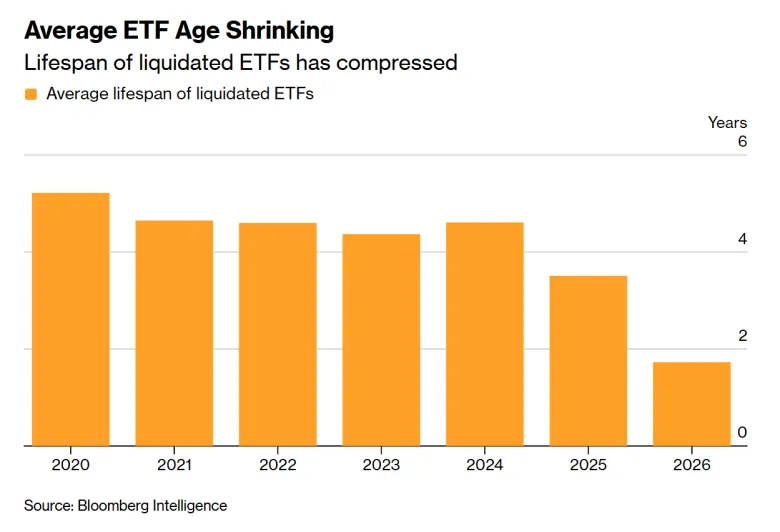
- Issuers are accelerating the closure of ETFs without investment inflows.
- The frequency of fund liquidations is increasing amid a record number of launches.
- The industry is losing tolerance for unsuccessful strategies.

This is reported by Business • Media
In 2026, the average lifespan of exchange-traded funds (ETFs) that were liquidated decreased to one year and nine months. In comparison, this figure was three years and six months in 2025, and four years and eight months in 2024. This trend is a result of increasing competition among issuers and their desire to close products that do not attract sufficient capital more quickly.
Reasons for the Reduction in ETF Lifespan
Market experts note that the main reasons for the reduction in ETF lifespan are the mass creation of new funds and intensified competition for investor resources. Over the past year, more than 1,000 new ETFs entered the market, significantly complicating fundraising and limiting the number of available niches. As a result, companies are liquidating funds that do not show desired results more quickly.
“If a product does not show success within 12–18 months, companies prefer to reallocate resources.”
In the first two months of 2026, over 40 ETFs were closed, while only 33 funds were closed during the same period in 2025. This indicates a growing intolerance in the industry towards strategies that do not yield quick results.
Impact of Competition and Specialized Products
The lowering of entry barriers to the market has led new asset managers to regularly launch investment products, but they face challenges in scaling and attracting capital. At the same time, experts emphasize that effective distribution—access of ETFs to brokerage and investment platforms—has become a key factor for success. Without this, funds cannot achieve a critical mass of assets.
Specialized products, particularly crypto-ETFs and leveraged funds, play an important role in the market. According to industry data, about 36% of new funds in 2025 belonged to these categories, which also affects market dynamics.
Additionally, there is an increasing volume of capital outflows from individual funds. By the end of March, approximately $296 million was withdrawn from spot Bitcoin ETFs, and over $206 million from Ethereum ETFs. During this period, negative capital movement was observed in six funds.
At the same time, the New York Stock Exchange (NYSE) listed a new spot Bitcoin ETF from Morgan Stanley, indicating further development of the cryptocurrency investment product segment.