

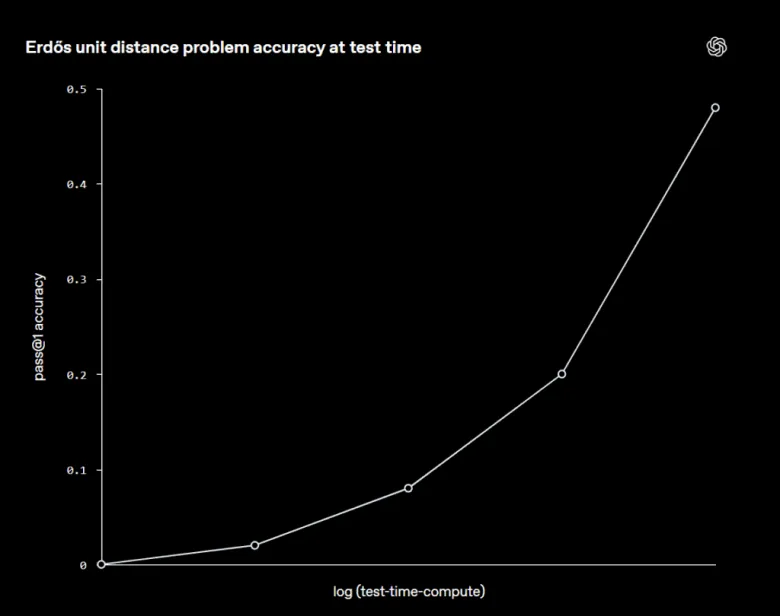
- OpenAI announced an original solution to an open mathematical problem using AI.
- This concerns a hypothesis formulated by Paul Erdős in 1946.
- Previously, OpenAI was criticized for exaggerating the mathematical achievements of GPT-5.
OpenAI announced that its new universal reasoning model created its own mathematical proof that disproves a hypothesis in the field of geometry proposed by Paul Erdős 80 years ago. The company emphasized that the AI did not find a ready-made proof in scientific sources but independently discovered a new approach to the problem.
This is reported by Business • Media

This statement gained widespread resonance, as in 2025, OpenAI was already embroiled in a scandal regarding GPT-5. At that time, the former vice president of the company, Kevin Vail, reported that the AI solved 10 unsolved Erdős problems at once, but it later turned out that the model was simply finding already known solutions in the scientific literature. After criticism from leading researchers, including Google DeepMind’s head Demis Hassabis and Meta expert Yann LeCun, Vail deleted his post.
In the new case, OpenAI published feedback from a number of renowned scientists who confirmed the uniqueness and significance of the result. Among them are Israel Prize laureate Noga Alon, Harvard University professor Melanie Wood, and British mathematician Thomas Bloom, who specializes in research on Erdős problems.
Autonomous discovery in a geometric problem
According to OpenAI, the mathematical community has believed for decades that the best solutions to this problem have a structure similar to square grids. The new AI identified a completely different class of constructions that turned out to be more effective than traditional approaches. The company emphasizes that this is the first case where artificial intelligence independently solved such a significant open mathematical problem, important for the development of the entire field.
OpenAI also noted that a universal reasoning model was used for this, rather than specialized mathematical software.
AI’s potential in fundamental science
According to company representatives, the ability of artificial intelligence to autonomously conduct complex logical searches can be useful not only in mathematics but also in biology, physics, engineering, or medicine. Currently, AI models are demonstrating gradual improvement in maintaining long chains of logical reasoning and are capable of combining ideas from various scientific fields.
Bloom, commenting on the result, stated that AI helps researchers “delve deeper into the cathedral of mathematics that humanity has built over centuries.”