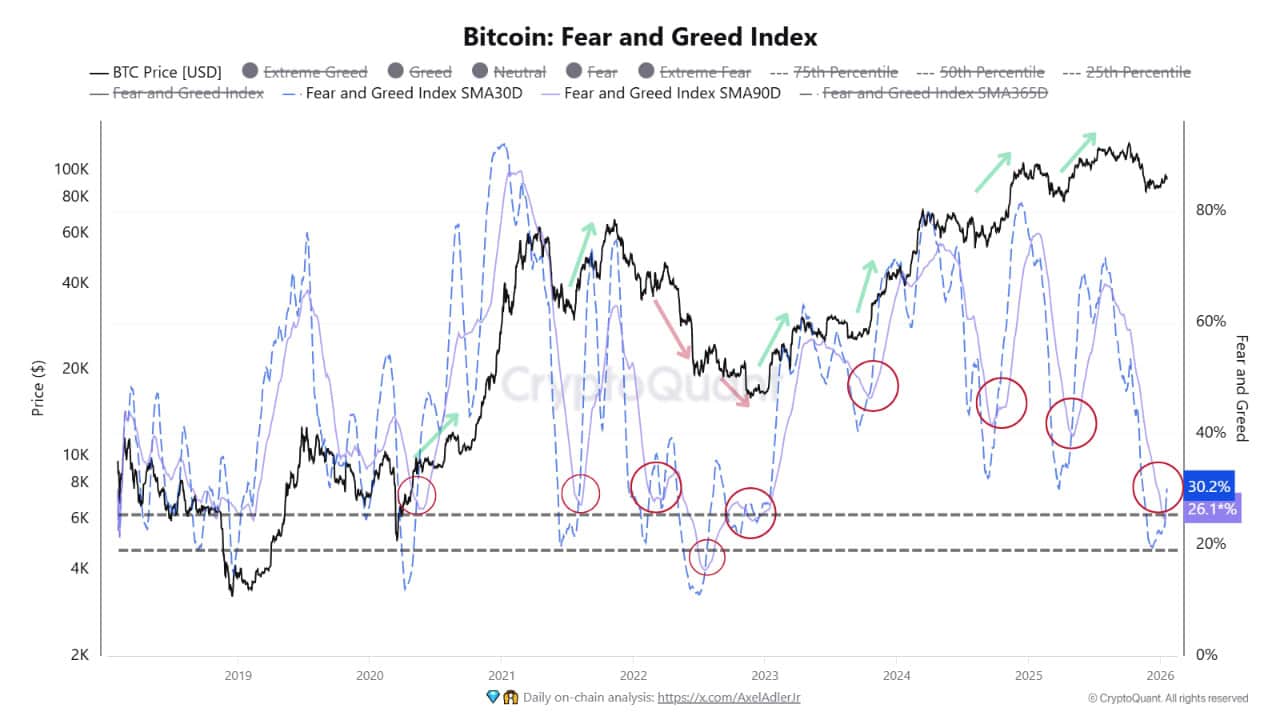
Analysts from the CryptoQuant platform have reported the formation of an important technical signal in the cryptocurrency market — a ‘golden cross’ on the Bitcoin Fear and Greed Index. This is the first time since May 2025 that the 30-day moving average of this index has exceeded the 90-day average, which historically indicates a shift in market sentiment towards optimism and the potential beginning of a bullish trend.
This is reported by Business • Media
What Does the ‘Golden Cross’ Mean for the Bitcoin Market
The formation of a ‘golden cross’ on the Fear and Greed Index is an important indicator of a change in short-term market expectations. Experts note that this signal typically arises not at the peak of market euphoria, but rather during skeptical sentiments, when volatility remains high and investor confidence is fragile.
At CryptoQuant, it is emphasized that it is not only the value of the Fear or Greed Index itself that matters, but also the dynamics of its changes relative to the long-term trend. Such crossings of moving averages are often observed after prolonged phases of fear and indicate a possible beginning of a price increase.
“Historically, such crossings appear after extended phases of fear — often near local price consolidation zones, rather than at major peaks. In most highlighted cases on the chart, the price has reacted positively in the following weeks,” the report states.
Potential for a Bullish Trend and Current Market Situation
Experts at CryptoQuant emphasize that the strength of the signal increases if the crossing is accompanied by the formation of new ‘higher lows’ on the chart and the absence of aggressive selling pressure. The widening between the 30-day and 90-day averages may indicate the beginning of an uptrend, while their convergence suggests the likelihood of protective selling due to excessive optimism.
As of now, the Fear and Greed Index for Bitcoin stands at 32 points, which corresponds to the ‘fear’ zone among traders. Recently, this indicator has already reached a peak since the market crash in October, indicating the persistence of unstable sentiments among market participants.