

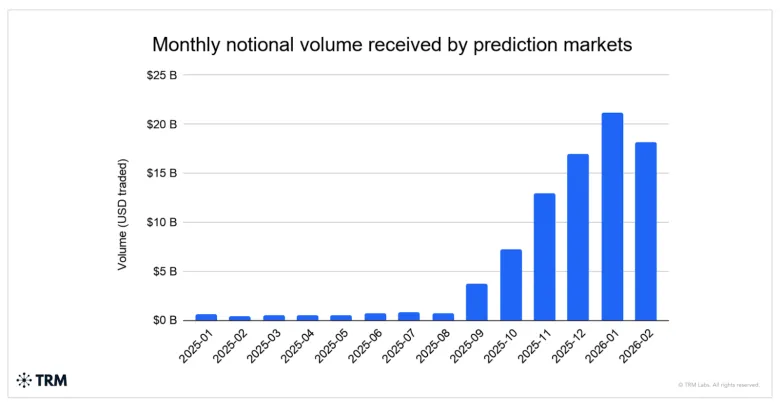
During 2025–2026, prediction markets have shown unprecedented growth in activity: the monthly trading volume increased from $1.2 billion to over $20 billion. The number of unique wallets has tripled in the last six months, reaching 840,000. At the same time, according to a new analytical report, traders’ main interest has shifted from cryptocurrency themes to geopolitical events.
This is reported by Business • Media
Geopolitical Markets Take Center Stage
According to the report, in October 2025, the five largest prediction markets covered topics such as the New York mayoral election, the winner of Super Bowl 2026, the Fed’s interest rate decision, the number of participants in the MegaETH token sale, and the price of Bitcoin at the end of October. However, by February 2026, the situation had radically changed: four out of the five most popular markets were related to geopolitics, particularly the escalation in the Middle East, while financial and economic topics were only represented by the Fed’s decisions.
Experts highlighted the main features of prediction markets on platforms such as Polymarket (this platform is banned in Ukraine, its mention is for informational purposes only):
- Geopolitics dominates, but liquidity is “spread out” among many often interrelated decisions.
- Political events in the U.S. remain the second most popular topic.
- There is no division of markets into “serious” or “non-serious” — all events are treated equally.
- There is no separate ranking by categories (goods, securities, etc.), which distinguishes these platforms from traditional exchanges.
User Structure and Behavior
The TRM Labs report analyzes user activity on prediction markets in detail. The most active wallets are those with 11–1,000 transactions — they account for almost 45% of all active addresses and $869 million in volume. Experienced traders (over 10,000 transactions) make up more than a third of addresses and generate $774 million in volume. Beginners represent only 0.2% of active addresses and $3.5 million in turnover.
The median transaction size for beginners is $30, while for experienced participants it is $12, indicating a trend of mass small trading. Both inexperienced and professional traders, including algorithmic ones, predominantly place bets on geopolitical markets, while cryptocurrency is taking a back seat. Entertainment and sports markets are the most popular among active users and market makers, but they remain less attractive to newcomers.
Based on the analysis of the top ten most profitable wallets, three main strategies were identified: focusing on macroeconomic events (for example, trading on both outcomes of Fed decisions), algorithmic market making, and event-driven opportunism.
At the same time, specialists have detected signs of insider trading and manipulation. For instance, four wallets turned $40,000 into $872,000 by simultaneously betting on a potential U.S. strike on Iran, using shared infrastructure and exiting the market at the same time.
“In a year, prediction markets have grown from a niche product into an ecosystem with a volume of over $20 billion per month. They could become an infrastructure for assessing the probabilities of events and compete with traditional analytics. However, there are also issues: market integrity, manipulation, the use of non-public information, and the lack of clear regulatory frameworks,” the experts concluded.
Previously, Kalshi and Polymarket had already implemented additional measures to counter insider betting on their platforms. This aims to enhance the fairness and transparency of digital prediction markets.


