

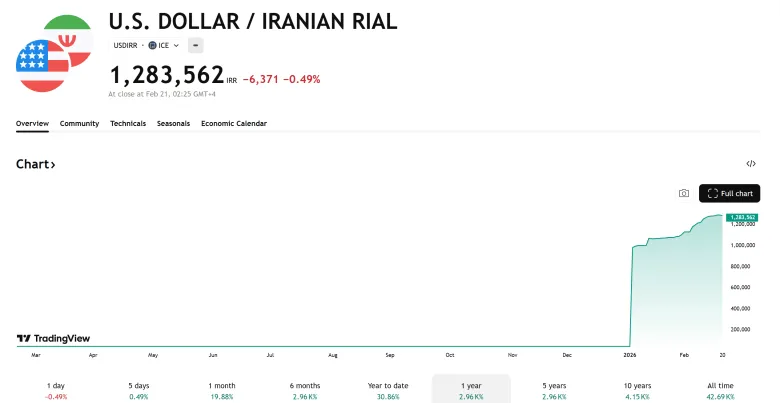
The sharp devaluation of the Iranian rial and hyperinflation have forced the country’s residents to seek alternative ways to preserve their funds, leading to a mass transition to cryptocurrencies, primarily Bitcoin.
This is reported by Business • Media
- Hyperinflation and financial sanctions are prompting Iranians to invest in digital assets.
- The experience of Lebanon shows that banking restrictions contribute to the spread of cryptocurrencies.
- The development of P2P transactions and non-custodial wallets is shaping an alternative financial system.

The Impact of the Financial Crisis on the Population’s Choices
Iran is facing serious economic challenges: international sanctions, rising inflation, and restrictions on access to global financial markets. Against this backdrop, Iranians are actively withdrawing their savings from the banking system, seeking to preserve capital in digital currencies. Experts estimate that the volume of cryptocurrency transactions in the country is already measured in billions of dollars.
Residents are increasingly using non-custodial wallets and P2P transactions to avoid blockages or further devaluation of their assets. Analysts note that this trend mirrors the scenario in Lebanon, where during the banking and currency crisis in 2019, a significant portion of the population lost their savings due to withdrawal restrictions and devaluation.
“The experience of Lebanon, analysts believe, shows that in times of financial instability, P2P trading rises sharply, and cryptocurrencies begin to be used for money transfers and everyday payments.”
A New Financial Reality: Cryptocurrencies Instead of Banks
A parallel financial system is gradually forming in Iran, where banks are losing their former influence. Decentralized services and personal wallets allow citizens to store and transfer funds independently of state restrictions. Despite challenges such as internet outages, power supply issues, and risks associated with using unreliable platforms, users are deepening their knowledge of secure asset storage.
Bitcoin is increasingly being used as a long-term savings tool, while stablecoins are becoming popular for daily transactions. This helps to compensate for the shortcomings of traditional banking infrastructure and maintain financial independence.
Analysts emphasize that crises in national currencies and banking systems stimulate interest in decentralized technologies. Iranians, like the citizens of Lebanon before them, are choosing cryptocurrencies as a response to the loss of trust in financial institutions and the desire to maintain control over their own funds.