

On the night of May 28, 2026, tensions between Iran and the US significantly escalated: both sides exchanged strikes, jeopardizing the ceasefire between the countries. The reaction of financial markets was swift — both cryptocurrencies and traditional market instruments felt the impact of the geopolitical escalation.
This is reported by Business • Media
Impact on the Cryptocurrency Market
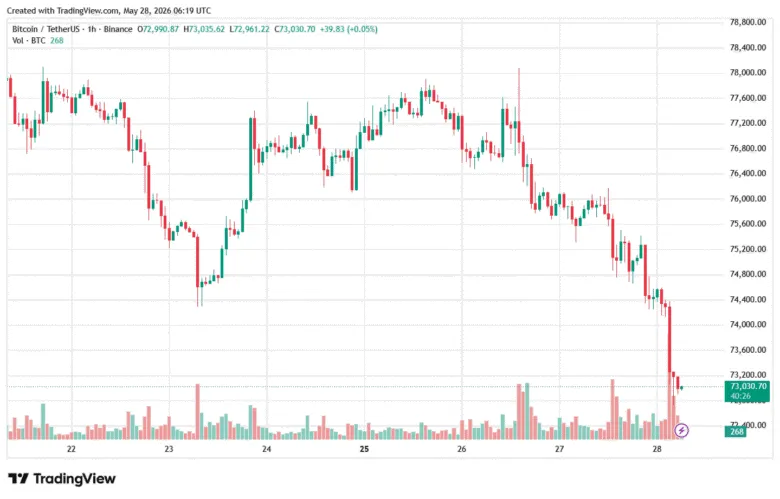
On the morning of May 28, the price of Bitcoin sharply dropped to $72,728, marking the lowest level in recent days. Over the course of the day, Bitcoin lost nearly 2% of its value, and around 5.8% over the week. Subsequently, the Bitcoin price recovered to the $73,000 level, but the market remained unstable.

The decline affected not only Bitcoin but also most other crypto assets. In some cases, the decrease exceeded 7%. Amid this volatility, there was a wave of liquidations of futures contracts: the daily volume of losses exceeded $934 million, with most of the closed positions being long.


The Fear and Greed Index fell by six points and remains in the deep “orange” zone, indicating heightened nervousness among investors.

Impact on Stock and Commodity Markets
The correction also affected traditional financial markets. Futures on the S&P 500 index fell by 0.12%, while the Nasdaq 100 dropped by 0.4%. Against this backdrop, WTI crude oil prices surged by over 3%, and Brent by 2.2%. The yield on 10-year US Treasury bonds also increased by 0.7%. These changes indicate a rise in inflation expectations amid geopolitical instability.
“On the morning of May 28, 2026, the Bitcoin price momentarily dropped to $72,728, according to TradingView. The likely cause of the correction is the exchange of strikes between the US and Iran, which threatens the ceasefire and future agreements.”
Escalation of the Situation in the Middle East
According to reports, the US struck four Iranian drones in the Strait of Hormuz area and attacked a drone launch facility near Bandar Abbas. The American side emphasizes the defensive nature of these actions aimed at preserving the ceasefire.
In response, the Islamic Revolutionary Guard Corps (IRGC) launched an attack on an American airbase, likely located in Kuwait, and targeted several vessels attempting to enter the Persian Gulf without permission. Iranian state media confirmed these strikes.
Additionally, the US Department of the Treasury’s Office of Foreign Assets Control (OFAC) imposed sanctions on the Persian Gulf Strait Authority (PGSA) — the agency responsible for the transit of vessels through the Strait of Hormuz. It is worth noting that Iran plans to charge fees for the passage of vessels in cryptocurrencies.
Moreover, tensions are rising in other countries in the region as well. Israel has carried out new military strikes on Lebanon, further destabilizing the situation in the Middle East. The combination of these factors significantly impacts all financial markets and increases uncertainty among investors.