

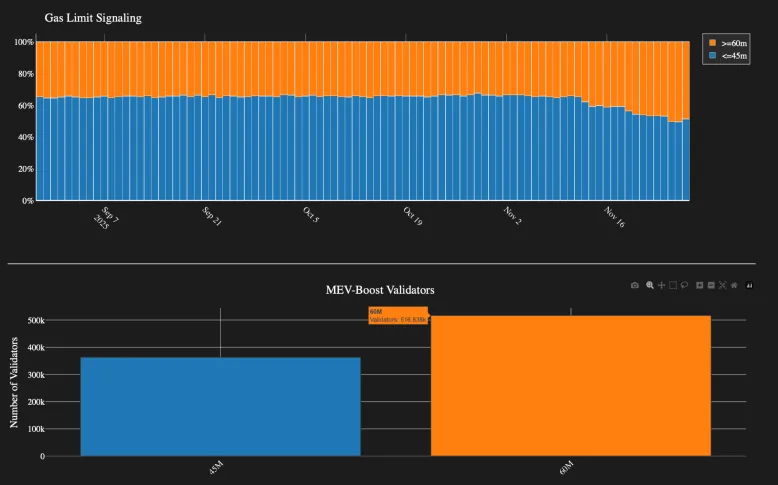
The Ethereum network has seen a significant increase in the gas limit — it has reached 60 million, marking the highest level in the last four years. In November 2025, over 516,000 validators supported this decision, allowing for an automatic increase in the limit according to the protocol.
This is reported by Business • Media

Impact of the Gas Limit Increase and History of Changes
The transition from the previous limit of 45 million gas to the new level of 60 million has led to an increase in the effective block size. This has enhanced the throughput of the network’s base layer, allowing for more transactions to be processed, including swaps, token transfers, and smart contract calls. The new limit reduces the likelihood of congestion during peak load periods and enables a greater number of operations at layer one (L1).
The initiative to raise the gas limit began in March 2024, when Ethereum developers emphasized that it was necessary for scaling the network. At that time, Eric Conner and Mariano Conti launched the Pump The Gas movement, urging solo stakers, client teams, pools, and the entire community to support the increase in the limit.
In February 2025, the gas limit was first raised to 35 million, and by May, it reached 60 million. This increase comes amid preparations for the important Fusaka update, which has already been tested on the Hoodi network at the end of October, with the mainnet launch scheduled for December 3. This update aims to further enhance Ethereum’s scalability.
Community Reaction and Future Development
The community emphasizes that setting the gas limit at 60 million is just the beginning of further changes. Ethereum Foundation researcher Tony Verchot noted that just a year after the push for increasing the limit began, the network is already operating with a limit twice as high as before, and this is only the start.
“Just a year after the community began advocating for higher gas limits, Ethereum is now operating with a gas limit of 60 million blocks. This is double what it was a year ago — and this is just the beginning.”
Vitalik Buterin, co-founder of Ethereum, agreed with this assessment, highlighting that further growth in network performance is expected next year due to “smarter adjustments.” He noted that Ethereum is moving towards increasing block capacity and implementing more efficient pricing mechanisms to ensure safe and measured scaling of the network, making inefficient operations more expensive.
Additionally, Buterin recently emphasized the need for “hardening” Ethereum, meaning stabilizing the core protocol, while further innovations should transition to layer two (L2).