

Results from a new international survey indicate a growing interest among users in integrating stablecoins into the traditional banking sector. Among the respondents, 77% expressed their willingness to open a cryptocurrency or stablecoin wallet in a banking or fintech application.
This is reported by Business • Media
Significant Demand for Stablecoins and Banking Services
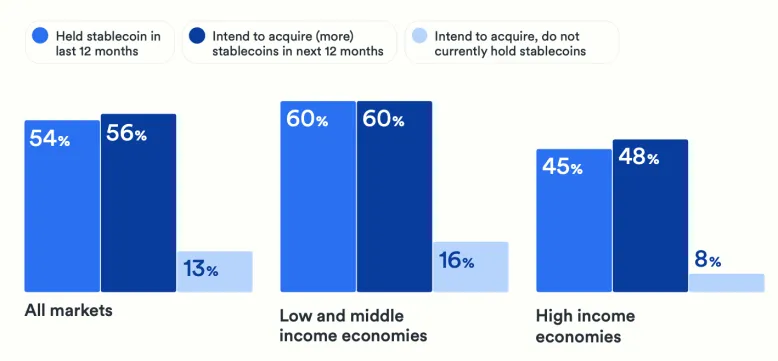
The survey, conducted by analytical firms for Coinbase and BVNK, included 4,658 adult users from 15 countries who already have experience with crypto assets or plan to gain it. The initiative was carried out online in September–October 2025. The results showed that 71% of respondents are willing to use a debit card linked to stablecoins, while 56% plan to acquire even more of these assets over the next year. Additionally, 54% have already owned stablecoins in the past 12 months, and 13% do not yet have digital assets but intend to start using them.

In 2025, the stablecoin market grew by 50% and for the first time exceeded the $300 billion mark, demonstrating their emergence beyond the crypto market and penetration into the traditional financial system. Users expect stablecoins to function similarly to conventional money. Key motivators for using digital currencies include lower fees (30%), increased security (28%), and global accessibility (27%).
“Users want stablecoins to behave like the money they already know.”
However, respondents noted that the processes of buying and using stablecoins are often complicated due to the numerous steps, network choices, and irreversibility of transactions. This creates demand for a simpler, more intuitive, and ‘bank-like’ user experience.
The Impact of Stablecoins on Income and International Payments
Stable digital currencies are already significantly impacting users’ incomes: on average, they account for 35% of the annual income of holders. 73% of freelancers and contractors acknowledge that it has become easier for them to work with international clients thanks to stablecoins, and three-quarters of users report a substantial improvement in conditions for conducting global business. Nearly half of the respondents increased their reserves of stablecoins over the past year, and this trend continues.
The highest usage rates are observed in low- and middle-income countries (60%), while in high-income countries, this figure stands at 45%, and in Africa, it reaches 79%.
Regulatory Clarity Stimulates Development
Analysts emphasize that further growth in the stablecoin market largely depends on transparent regulation. The example of the United States, where the GENIUS Act is currently under consideration, illustrates the desire to establish standards for transparency and cybersecurity by classifying stablecoins as reliable monetary equivalents.
“By establishing standards for transparency and cybersecurity, this act classifies these assets as reliable cash equivalents.”
Experts believe that such regulatory clarity strengthens institutional trust in stablecoins and enhances consumer protection. They argue that this will lead to the widespread adoption of digital assets in the coming months and years.
Previously, Gate CEO Lin Han noted that traditional banks have effectively lost the competition to stablecoins in the field of payment solutions.