


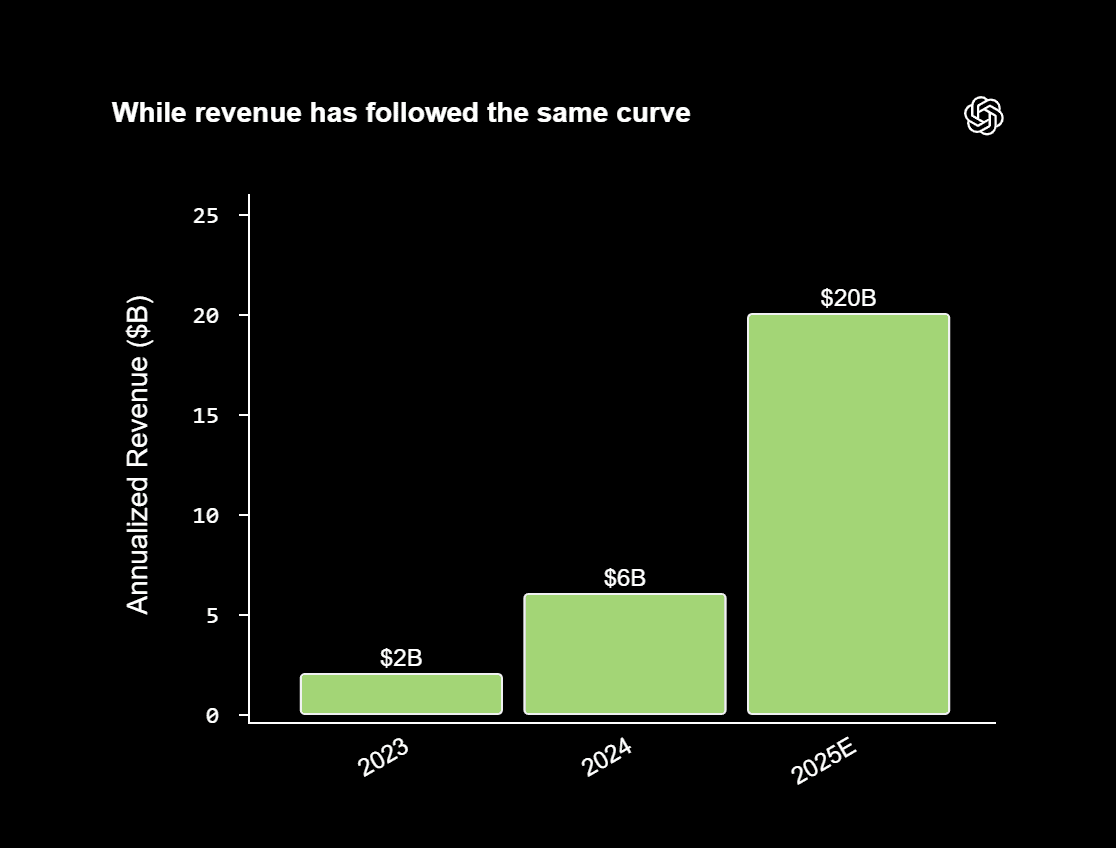
OpenAI achieved a record financial result in 2025, increasing its annual revenue to over $20 billion, more than three times the figures from 2024.
This is reported by Business • Media
Infrastructure Development and Revenue Growth
As stated by the company’s CFO, Sarah Friar, this growth was made possible by scaling the computational infrastructure. In 2025, OpenAI’s total capacity reached 1.9 GW, compared to 0.6 GW in 2024 and 0.2 GW in 2023. Friar emphasized that the company’s revenue dynamics are in line with the increase in computational resources.
The company is also demonstrating record user activity, both daily and weekly. The OpenAI platform, operating in partnership with Microsoft, covers a variety of areas: working with text, images, voice, code, and APIs. The application of OpenAI services extends beyond testing and is increasingly integrated into the daily business processes and work practices of various companies.
Strategy and Plans for 2026
In her blog, Friar highlighted that OpenAI’s business model has changed over the years: the company has transformed from a research project into a scalable commercial platform. Key monetization factors include expanding consumer and corporate subscriptions, utilizing a pay-per-API model, and implementing advertising and commercial features in ChatGPT, which helps offset rising infrastructure costs.
“What started as a tool to spark curiosity has turned into an infrastructure that helps people create more, make decisions faster, and work at a higher level,” said OpenAI’s CFO.
Friar specifically noted that in the field of artificial intelligence, computational resources remain scarce. While OpenAI previously relied on a single supplier, the company now collaborates with a wide network of partners, providing flexibility in equipment choice and cost optimization.
In 2026, OpenAI plans to focus on the practical implementation of AI, particularly in the fields of healthcare, scientific research, and corporate governance. The new phase of the company’s product development will be aimed at creating agents and automating business processes—solutions capable of operating autonomously, maintaining context, and performing tasks across various systems.
Additionally, the company is preparing to launch its first hardware device in the second half of 2026, which analysts believe could open new opportunities for monetization and expand the OpenAI ecosystem.
It is worth noting that earlier, Elon Musk demanded compensation from OpenAI and Microsoft of up to $134 billion.