

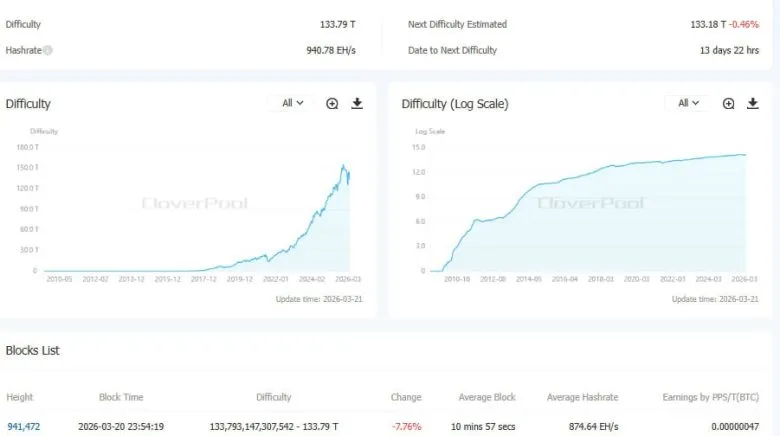
On March 20, 2026, the difficulty of mining Bitcoin fell by 7.76%, reaching a level of 133.79T. This change was one of the largest this year. According to the CloverPool platform, the average network hash rate currently stands at around 874 EH/s.
This is reported by Business • Media
Reasons and Consequences of the Difficulty Decrease
The decrease in difficulty directly impacts the potential profitability of miners, as they can generate more Bitcoins while maintaining the same level of computational power. StandardHash highlighted that this process increases mining efficiency and facilitates participation in coin extraction for active market players.

Difficulty Adjustment Mechanism and Forecast
The difficulty of Bitcoin mining is a dynamic indicator that reflects how much harder it is to find a new block compared to the easiest period in the network’s existence. This parameter is automatically adjusted every 2016 blocks, which corresponds to approximately two weeks. The next difficulty recalculation is expected in early April, around the 3rd or 4th.
Crypto analyst Colin Wu points to the likelihood of further difficulty decreases in the near future, which could stimulate additional interest in mining.
“StandardHash noted that the decrease in difficulty means an increase in mining efficiency. With the same computational power, miners can generate more Bitcoins. This, in turn, increases the potential profitability of network participants.”
For comparison, on February 19, 2026, the difficulty level sharply increased by 14.73% after a resurgence in miner activity, which had previously been limited by weather conditions. Experts linked these changes to the stabilization of equipment operations and the return of power to the network.