

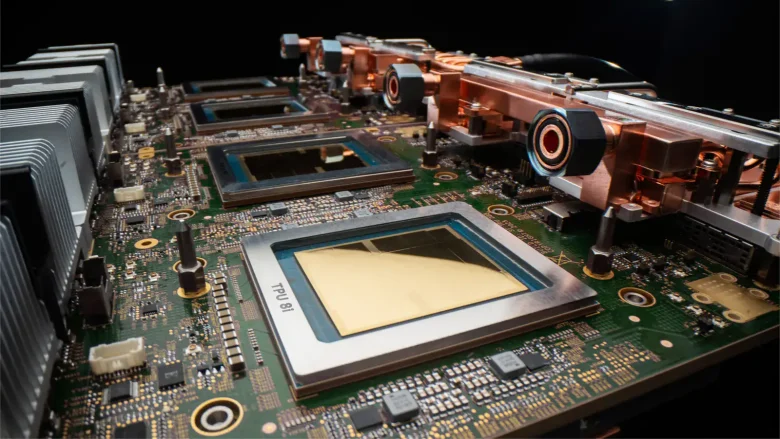
Google Cloud has introduced a new generation of chips for artificial intelligence — the 8th generation TPU, which provides significant acceleration in training models and optimizing the subsequent use of AI technologies.
This is reported by Business • Media
Two Types of Chips for Different Tasks
Google engineers have divided the TPU 8 lineup into two specialized solutions: TPU 8t, optimized for training large AI models, and TPU 8i — for servicing and operating already created models in real-time. According to the company, the new chips provide up to three times faster AI training compared to the previous generation.

The TPU 8 also allows for up to 80% better performance for every dollar spent compared to previous models. The updated infrastructure enables the combination of over 1 million TPUs in a single cluster, significantly expanding computational scalability while reducing energy consumption.
Development Strategy and Collaboration with Nvidia
Google emphasizes that the goal of implementing the new chips is to optimize all stages of working with AI, from training to processing user requests. The company follows a hybrid strategy, combining its own technologies with innovations from Nvidia, which remain extremely important for the market.
“The company highlighted that the new solutions are aimed at optimizing various stages of working with AI — from training to processing user requests. At the same time, the corporation continues to use a hybrid approach, combining its own developments with Nvidia’s technologies.”
Google’s cloud platform will gain access to the new Vera Rubin chip as early as 2026. This indicates that despite the development of its own solutions, Google is not abandoning collaboration with Nvidia; on the contrary, it is strengthening its partnership in the field of networking technologies. In particular, the companies are working on the Falcon technology, which enhances the efficiency of interaction among computing systems in data centers.
Analysts note that not only Google but also giants like Microsoft and Amazon are actively developing their own specialized chips for AI, which in the near future may reduce their dependence on external suppliers.
Experts assert that the launch of the new TPUs confirms Google’s ambitions for large-scale development of infrastructure for artificial intelligence while maintaining a balance between innovation and key partnerships in the industry.