

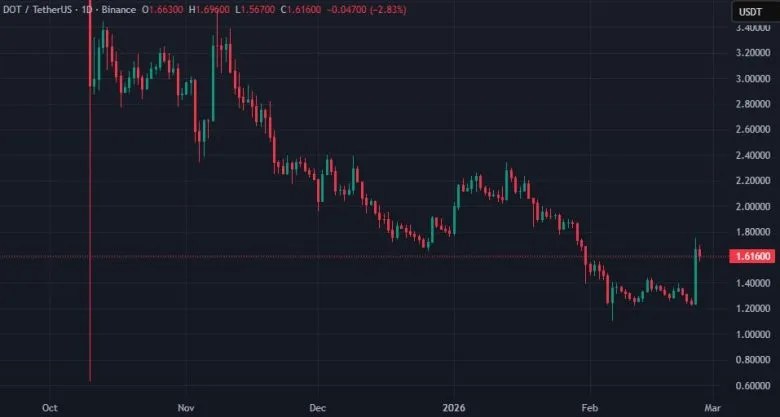
On February 25, 2026, the cryptocurrency Polkadot (DOT) demonstrated rapid growth, adding over 40% in a single day. At its peak, the market capitalization of the asset rose from around $2.15 billion to nearly $3 billion, making it one of the largest movers among major cryptocurrencies in February.
This is reported by Business • Media

Key Drivers of DOT’s Price Increase
Market experts point to several reasons for this significant surge. One of the main factors is the upcoming halving of Polkadot, scheduled for March 14, 2026. This will be the first reduction in the annual issuance of DOT tokens by more than 50%, transitioning the network to a deflationary model and significantly decreasing the new supply of the asset.
Another significant driver is the submission of applications for the launch of exchange-traded funds (ETFs) based on DOT by well-known companies such as Grayscale and 21Shares. Technical factors also played a role in the growth: the token managed to break through the 20-day exponential moving average and establish itself above the resistance level of $1.40, maintaining support at $1.23.
Analysts’ Comments and Market Narrative
Entrepreneur and founder of The Inner Circle, Lark Davis, noted in his analysis that Polkadot “surprised the crypto community with a 41% increase.” He considers the main reasons to be the halving, ETF applications, and the technical breakthrough of DOT.
“While other L1 networks are struggling for memes, DOT is completely revising its economic model.”
The crypto researcher known as CryptoXact also links the dynamics to the expectation of a shortage of DOT tokens. In his opinion, the cap on total issuance at 2.1 billion tokens, combined with the halving, eliminates fears of “endless inflation” in the Polkadot network. The analyst also emphasized that the updated market narrative is attracting attention and could serve as a catalyst for further growth if technical changes are successfully implemented.
It is worth noting that in the fall of 2025, the Polkadot DAO community established a hard cap on token issuance — 2.1 billion DOT, which also laid the groundwork for the current growth and the formation of a deflationary model.