


On December 10, 2025, the Federal Open Market Committee (FOMC) will hold a meeting to decide the future direction of monetary policy in the U.S. This time, market expectations are particularly tense, as uncertainty regarding future interest rate movements has increased due to political factors and a limited statistical base.
This is reported by Business • Media
Probability of a Rate Cut and Market Expectations
Investors predominantly predict another easing of policy. According to the CME FedWatch Tool, the probability of a rate cut by another 25 basis points currently stands at 87.6%. On the Polymarket platform, this probability is assessed even higher — at 96.6%. The likelihood of a more radical move, such as a 50 b.p. cut, is estimated by the market at less than 1%, while the chance of maintaining the current rate is at 2.9%.
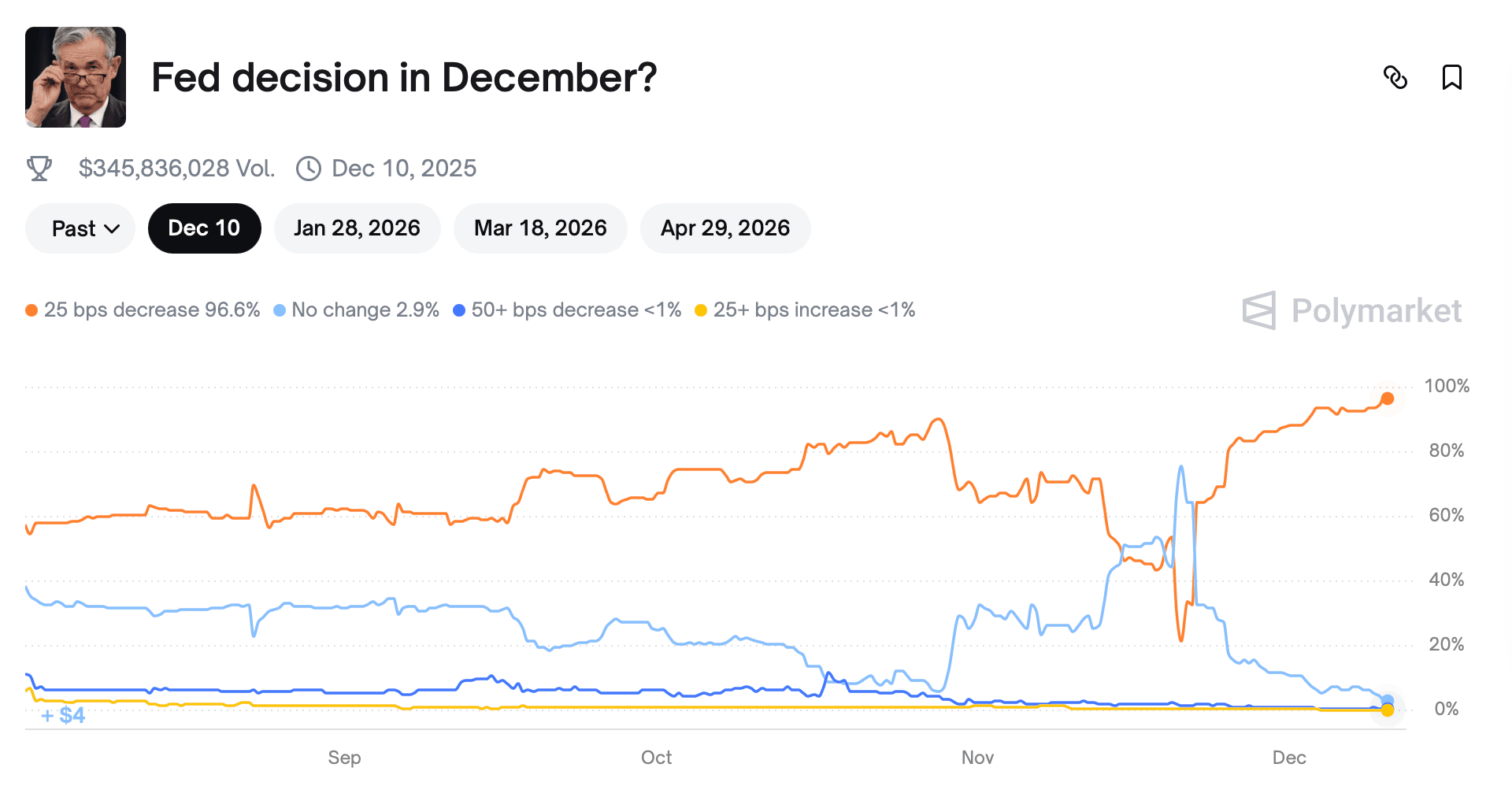
Experts believe that the December meeting could be the most challenging of 2025. This is due to both political pressure and the lack of key economic data for October caused by a prolonged government shutdown in the U.S. (from October 1 to November 12). Data on inflation and employment for October were not collected, and reports for November will only become available after the meeting — on December 16 and 18, respectively. This forces FOMC members to make decisions without the most current information.
Expert Predictions and Political Pressure
After the October rate cut of 0.25% (to a range of 3.75–4%), markets expect the Fed to continue the easing trend. However, analysts warn of a potential pause in further cuts. As noted by Peter Cardillo, Chief Market Economist at Spartan Capital Securities, the market may anticipate a signal for a pause in rate cuts in the first quarter of 2026.
“The market may expect that the Fed signals a pause in the first quarter of 2026 after this cut, although I disagree with that.”
For their part, analysts at BofA Global Research predict another cut of 25 b.p. in December, with two more cuts possible in 2026. They attribute this not only to macroeconomic factors but also to a potential change in Fed leadership.
Political pressure on the Fed is also intensifying. Kevin Hassett, Chair of the National Economic Council and a potential candidate for the Fed chair position, stated that there is “plenty of room” for a cut beyond 25 b.p. U.S. President Donald Trump, who will appoint a new Fed chair at the beginning of 2026, has expressed the need for swift action on rate cuts.
He emphasized:
“Since January 2025, we have stopped inflation. […] We have managed to bring it down to an acceptable level. We intend to reduce it a bit more.”
CNBC analysts predict a so-called “hawkish cut” — the rate is likely to be lowered, but the Fed’s rhetoric will be cautious regarding further steps. Goldman Sachs expects that Fed Chair Jerome Powell will highlight the position of committee members who oppose further rate cuts. Meanwhile, John Williams, President of the Federal Reserve Bank of New York, stressed that the weakness in the labor market currently outweighs inflation risks.
Against this backdrop, Bitcoin is trading at $92,665 according to TradingView. The dynamics of digital asset prices remain sensitive to Fed decisions, as U.S. monetary policy influences the appetite for riskier investments.
