

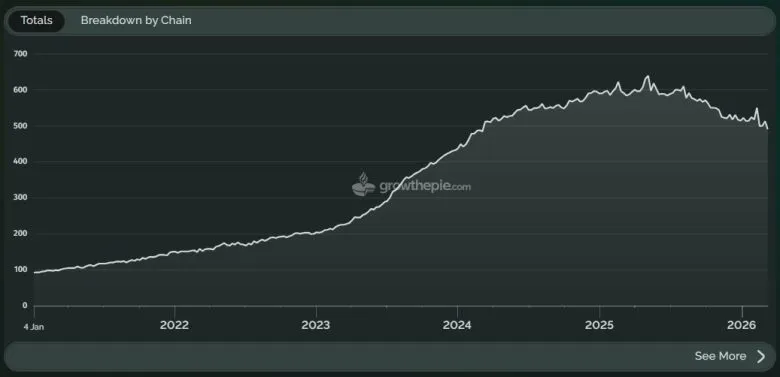
The number of second-layer (L2) solutions in the Ethereum network, where the total value locked (TVL) exceeds $100,000, continues to decline despite the launch of new projects. According to analytics from Growthepie, the market shows signs of transitioning to a consolidation phase, where only the strongest and most resilient projects maintain their positions.
This is reported by Business • Media
Dynamics of L2 Network and Application Activity
Analysts note that even with the emergence of new L2 solutions, a significant portion of them quickly loses activity or ceases to exist altogether. This leads to a gradual decrease in the number of stable projects in the market. A similar trend is observed for applications: over the past week, approximately 490 active projects receiving transactions were recorded, while previously this figure reached 639. Such changes indicate a redistribution of activity within the ecosystem.
“Layer 2s are also consolidating. Here we track the number of Layer 2s with at least $100k TVS. To be clear, new layer 2s are being deployed but we are seeing larger amounts winding down. Hover this chart to see which chains were added/removed each month.”
Despite this, the overall level of activity in the Ethereum network is not decreasing: the load is concentrating on market leaders, who are strengthening their positions and accumulating liquidity.

Review of the Role of L2 in Scaling Ethereum
Experts believe that the current consolidation is natural for a mature ecosystem: less efficient solutions are gradually disappearing, making way for scalable and resilient protocols. Ethereum co-founder Vitalik Buterin has also pointed out that the initial concept of scaling through L2 no longer aligns with modern realities. According to him, L2s were initially seen as “branded shards” of the main network, which were supposed to handle the primary load while maintaining first-layer security guarantees. However, this approach is being implemented more slowly than expected.
Buterin emphasizes that the transition of L2 solutions to full decentralization is occurring gradually. At the same time, Ethereum itself continues to develop actively, prompting a reevaluation of the role of second-layer solutions in the architecture of the network.
It was previously reported that the Robinhood platform has already launched a test version of its own L2 blockchain for trading tokenized assets, indicating a sustained interest in the development of innovations in Ethereum scaling.