

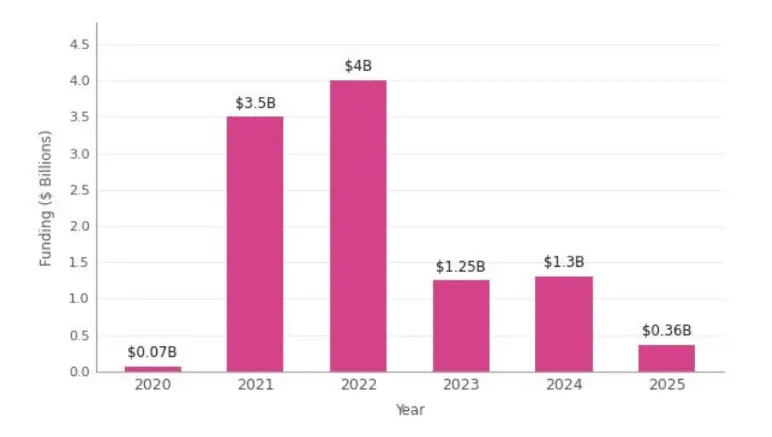
The Web3 gaming sector is experiencing a serious crisis: according to an analytical report by Caladan, 93% of projects in this area are currently classified as “dead” — meaning their activity is minimal or nonexistent. Despite some positive signals at the beginning of 2026, the situation remains critical, with the average loss in token value reaching 95%.
This is reported by Business • Media
Reasons for the Decline and Redistribution of Investments
According to Caladan’s data, from 2020 to 2026, the Web3 gaming sector attracted between $12 billion and $15 billion in venture investments. The largest influx — around $4 billion — was recorded in 2022, when the share of GameFi in total Web3 investment reached 62.5%. However, after that, there was a sharp decline due to the so-called crypto winter, massive capital losses, and high-profile incidents like the Ronin bridge hack worth $625 million.
Over time, investors began to redistribute funds: in 2026, the main capital is shifting to artificial intelligence ($1.8 billion), tokenized real assets ($2 billion), and infrastructure ($2.6 billion). A significant number of studios, such as Mojo Melee, Planet Mojo, and Treasure DAO, publicly announced a shift in specialization from GameFi to AI projects.
“The GameFi sector not only diminished its own capital. The fact that it ‘captured’ 62.5% of venture investments at its peak had consequences for the entire industry, which was left without capital at a crucial stage of development.”
Among the main reasons for the collapse, experts cite premature token and NFT sales before product release, multi-year delays in launches, financially unviable P2E models, management failures, conflicts and abuses, as well as endless development.
Failure Cases and Sector Dynamics
A striking example of failure is Axie Infinity, whose daily active user count dropped from 2.8 million to 99,000 by the end of 2025. Similar problems were observed in other projects — Pixelmon, which raised $70 million, never released a final product, while Wilder World, with over $60 million in investments, remained in early access, with its token losing 96% of its value.
In 2025-2026, the sector saw a massive exit of players and studios: in the second quarter of 2025 alone, over 300 projects closed, including Ember Sword, Nyan Heroes, MetalCore, Bloktopia, and others. Investments in Web3 gaming in May 2025 amounted to only $9 million, and the number of deals remained below 15 per quarter. The massive decline also affected T2E projects in Telegram: for example, the capitalization of HMSTR fell from $300 million in August 2024 to $12 million in February 2025.
Some promising games and studios, such as Gala Games and Off the Grid, faced collapse due to internal issues rather than just market conditions. Meanwhile, among the few successful ones remained mostly simple games or those that combine Web2 and Web3.
Current State and Prospects
As of April 2026, the situation has not improved: stablecoins are gradually replacing native tokens, the number of inactive dApps is increasing, and the average asset drawdown reaches 95%. Despite this, some projects (for example, the shooter Off the Grid) managed to go public and even demonstrated token growth at the beginning of the year, while user retention rates slightly increased.
However, experts note a general degradation of the sector: major conferences, such as NFT Paris, are being canceled, token delistings are occurring on exchanges, and the number of new solutions is decreasing.
“The failure rate in the sector exceeds even the most affected segments of the dot-com era. Open-world games, photorealistic metaverses, and AAA shooters, on which the investment narrative was built, were mostly unrealized or abandoned. Entire economic layers were built on the assumption of infinite growth and collapsed when growth stopped,” experts concluded.
The further development of Web3 games directly depends on the ability of the few surviving projects to form sustainable business models and regain investor interest.