

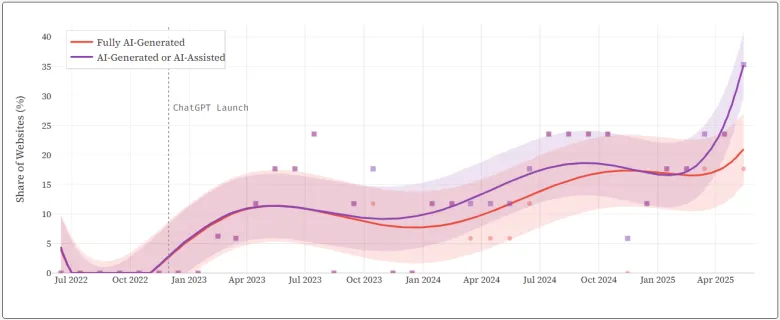
A new research report confirms a significant increase in the use of artificial intelligence in website creation. According to experts from Stanford, Imperial College London, and Internet Archive, by mid-2025, over 35% of new internet resources were developed using AI.
This is reported by Business • Media
Growth Dynamics and Research Methods
The study covered websites that emerged between 2022 and mid-2025. The authors note that prior to the launch of ChatGPT in late November 2022, AI-generated content was almost nonexistent. The analysis utilized the Pangram v3 service, which demonstrated the best results in recognizing texts created by artificial intelligence.
Since mid-2022, the number of web resources fully or partially created with the help of AI began to rise sharply. By May 2025, the share of such websites reached 17.6% (fully AI-generated) and 35.3% (with AI involvement).

The Impact of AI on Content Uniqueness and User Attitudes
As part of the study, a survey was conducted among 853 respondents from the USA. More than half of the participants regularly use artificial intelligence technologies, and 44% express a positive attitude towards this phenomenon.

Experts highlighted six potential negative consequences of the spread of AI content: semantic reduction (fewer unique ideas), an increase in false information, dominance of positive tone, emergence of “epistemic islands” (responses without confirmations), dilution of entropy (excessive content with loss of meaning), and the formation of stylistic monoculture.
- semantic reduction (fewer unique ideas);
- increased share of false information;
- shift towards positive perception (sterile texts, artificially cheerful content);
- epistemic islands (responses without real confirmations and unfounded claims);
- dilution of entropy (constant growth of AI-generated content, loss of meaning);
- stylistic monoculture (loss of individuality).
In practice, it has been confirmed that websites with AI content have 33% higher semantic similarity and 107% more positive tone. At the same time, three hypotheses regarding negative impact found no confirmation, while a slight direct correlation regarding monoculture is observed.

Experts emphasize the speed at which artificial intelligence is taking over the digital space, changing the landscape of the internet in just three years.
“After decades in which humans shaped it, a significant part of the internet has become defined by AI in just three years. In my opinion, we are witnessing a massive transformation of the digital landscape in a much shorter time than it took for its initial creation,” said one of the authors, Jonáš Doležal, in a comment to 404 Media.
Earlier, the Anthropic report noted that the growth in AI usage raises concerns among workers about their own roles, and there is a clear correlation between the frequency of technology use and the level of fear regarding its impact.