

The Financial Stability Board (FSB) has published its final report for 2025, in which stablecoins are identified as one of the most serious risks to the economies of developing and emerging market economies (EMDE).
This is reported by Business • Media
Main Risks of Stablecoins’ Impact on the Financial System
The document emphasizes that the proliferation of stablecoins could negatively affect financial stability, particularly by diminishing the role of national currencies, complicating the implementation of monetary policy, and leading to a loss of control by regulators. The FSB highlights the following threats posed by stablecoins:
- weakened financial transparency and integrity of the system;
- increased risks of illicit financial activities;
- threats to personal data protection;
- potential cyber threats;
- risks to consumer and investor rights;
- threats to the integrity of financial markets;
- negative impacts on budgetary and macroeconomic stability.
Increase in Transaction Volumes and Limited Capabilities of EMDE Countries
The FSB underscores that the listed risks are particularly relevant for developing countries due to limited resources and weak institutions, as well as high demand for stablecoins due to their cross-border nature and low remittance costs.
“Stablecoins destabilize financial flows, reduce the use of national currencies, and consequently, the effectiveness of monetary policy.”
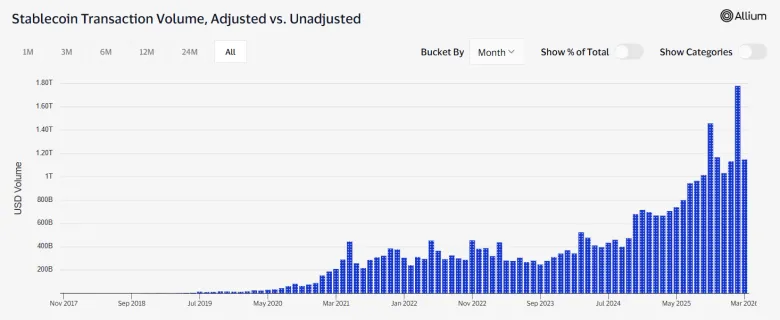
According to data provided by the FSB from the Visa dashboard, transaction volumes involving stablecoins significantly increased in 2025, reaching a historical monthly high of $1.78 trillion in February 2026.

Despite the rapid growth in circulation, FSB experts believe that the practical use of crypto assets, including stablecoins, remains limited.
It is worth noting that the FSB is funded by the Bank for International Settlements (BIS), which also published a review of the risks associated with the implementation of stablecoins for the global financial system in June 2025.