

- The innovative architecture eliminates the problem of “infinite regress” in artificial intelligence.
- The system independently modifies its improvement and learning mechanisms.
- HyperAgents demonstrate effective skill transfer across different domains.
HyperAgents: A New Step in the Development of Self-Learning Systems
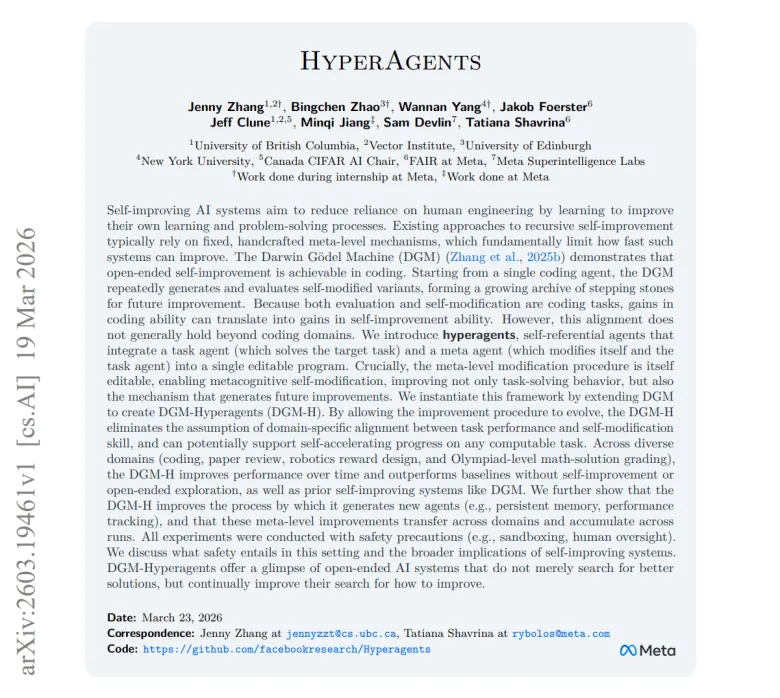
The Meta AI team, along with leading universities, has presented a revolutionary artificial intelligence architecture called HyperAgents. The main feature of this system is its ability not only to perform tasks but also to independently enhance its own learning methods, enabling the realization of the idea of open self-improvement, which until recently remained merely a theoretical concept.
This is reported by Business • Media
The foundation of this new approach lies in the development of the Darwin Gödel Machine (DGM) concept, which previously allowed for a certain level of self-improvement but was limited by fixed human-defined meta-level mechanisms. The Meta AI team has managed to overcome these limitations.
The implemented DGM-Hyperagent model integrates task execution and a self-improvement module into a single system. This allows not only for the optimization of solutions but also for changing the very logic of their enhancement, eliminating dependence on pre-programmed algorithms. The main breakthrough is metacognitive self-modification—the system’s ability to rewrite its own rules and development mechanisms. Thus, the hyperagent independently improves even the mechanisms for future enhancements.
“HyperAgents have managed to transfer self-improvement strategies to new domains where they initially had not been trained, which experts believe is a significant step for the development of autonomous artificial intelligence systems.”
Practical Applications and Autonomy of HyperAgents
The development has already been tested in several key areas: robotics, scientific paper review, and mathematical problem assessment. In all cases, HyperAgents demonstrated significantly better results compared to baseline models. For example, in the field of robotics, the hyperagent transitioned from simple strategies to more effective solutions, optimizing robot behavior. In scientific review, the system created multi-level evaluation processes with clear criteria.
An important feature of the new architecture is the ability of hyperagents to transfer skills: they can apply self-learning strategies in new domains without prior training in those areas. This opens up possibilities for creating universal and autonomous AI systems of the future.
Another significant achievement is the ability of HyperAgents to independently form their own infrastructure to enhance efficiency. The system developed tools for performance monitoring, created persistent memory, and implemented mechanisms for planning computational resources. As a result, hyperagents can analyze previous iterations and adjust their improvement strategies without human intervention.
Researchers emphasize that hyperagents are capable of going beyond local solutions, forming generalized approaches to learning, which could serve as the foundation for creating universal artificial intelligence systems. According to the project authors, the new architecture overcomes key limitations of previous models and paves the way for scalable self-improvement of AI across various fields.