

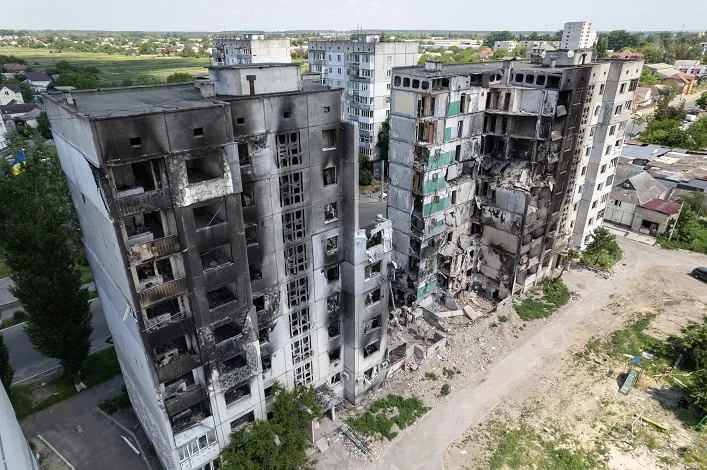
Ukraine is experiencing the largest housing crisis in its years of independence, a consequence of the full-scale invasion by the Russian Federation. According to estimates by the International Organization for Migration (IOM), over 236,000 residential buildings have been destroyed or severely damaged across the country. This has resulted in approximately 10% of the existing housing stock becoming completely uninhabitable or requiring significant repairs.
This is reported by Business • Media
Housing Shortage and Financial Burden on Displaced Persons
The lack of sufficient municipal housing, an unregulated rental market, and a significant influx of forced migrants have created additional pressure on housing availability throughout Ukraine. It is estimated that nearly a quarter of the country’s population before the war – about 10.6 million people – have left their homes. The vast majority of them were forced to flee abroad. However, 3.7 million internally displaced persons remain within Ukraine. Most of them, specifically 65%, are facing difficulties in paying rent for new housing. Many families have already exhausted their savings and are spending more than half of their income on housing.
“Almost 25% of the pre-war population of the country – around 10.6 million Ukrainians – were forced to leave their homes. Most of them went abroad. In Ukraine, there are still 3.7 million internally displaced persons, 65% of whom have had difficulties paying for new housing, leading many families to deplete their savings – they are forced to spend 50% or more of their income on rent.”
New Environmental Projects for Displaced Persons
The issue of providing housing for internally displaced persons remains one of the key challenges for the state and international organizations. In the midst of this crisis, new initiatives are emerging: in particular, the metallurgical company “Metinvest,” in partnership with the Italian Ai Studio/Ai Engineering, is developing a concept for a new environmentally-oriented microdistrict in the city of Trostyanets in the Sumy region. The project is planned to accommodate 11,600 residents, which will help partially address the housing problem for displaced persons in the region.
In the context of a protracted war and large-scale migration processes, finding long-term solutions for housing remains one of the most important issues for the future of the country.