

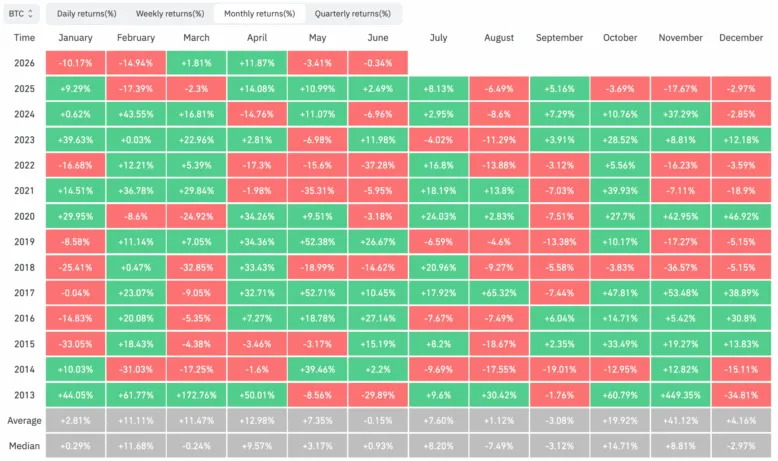
In May 2026, Bitcoin and Ethereum showed negative dynamics, closing the month with a significant decrease in value. According to CoinGlass, the price of Bitcoin dropped by 3.41%, while Ethereum lost over 11% of its value. This marks the seventh instance in history where Bitcoin has experienced a correction in May, and only the fourth for Ethereum.
This is reported by Business • Media
“In May 2026, the cryptocurrency market ended the month in the ‘red zone.’ Bitcoin lost 3.41%, while Ethereum fell by 11.07%, according to CoinGlass.”
Geopolitical Risks and Historical Correction of the Crypto Market
The market decline occurred against the backdrop of geopolitical tension: at the end of the month, the escalation of the conflict in the Middle East — particularly exchanges of strikes between Iran and the USA — led to a loss of investor confidence. Amid this, Bitcoin temporarily fell below the $73,000 mark, and both stock and cryptocurrency markets entered a correction phase.
Despite fundamental changes in the Ethereum ecosystem, including the development of Ethereum ETFs and initiatives to enhance privacy and security, this asset showed worse dynamics than Bitcoin, recording a decline of over 11%.
In April, the situation was the opposite: Bitcoin gained 11.87%, while Ethereum rose by 7.3%. However, in May, investors faced a series of negative factors that intensified pressure on the market.
Mass Outflow of Funds from ETFs and the Impact of Institutional Players
A key negative factor for the market was the record capital outflow from exchange-traded funds based on Bitcoin and Ethereum. From May 1 to May 29, spot Bitcoin ETFs experienced the largest monthly outflow in 2026 — $2.43 billion (SoSoValue). Positive dynamics were observed only during the first trading week, after which investors consistently withdrew funds.
The largest losses were recorded by the IBIT fund from BlackRock — $1.41 billion. Among all funds, only the Morgan Stanley Bitcoin Trust demonstrated growth, attracting $68.98 million.
In the Ethereum ETF sector, the situation was similar. The net outflow amounted to $540.88 million — the highest negative figure for this year. For the fourth consecutive month, Ethereum-based funds ended with losses, with a positive result recorded only in April. The main losses were concentrated in four large funds, including iShares Ethereum Trust (ETHA). At the same time, five funds recorded capital inflows, with the leader being iShares Staked Ethereum Trust ETF (ETHB) attracting $35.73 million.
Particular attention was drawn to Yorkville America, which, in collaboration with Trump Media & Technology Group (TMTG), withdrew its application to launch a spot Truth Social Bitcoin ETF and suspended the development of two more funds. The official reason cited was structural deficiencies under the Securities Act of 1933, although experts linked this to high competition in the industry.
The market was also influenced by the actions of Strategy: at the beginning of the month, co-founder Michael Saylor announced a possible sale of part of the Bitcoin reserves to cover dividend obligations. At the end of May, the company transferred over 411 BTC to Coinbase Prime, sparking speculation about a potential asset sale.
Additional pressure on investor sentiment was created by data from CryptoQuant: the Apparent Demand indicator for Bitcoin dropped to -147,000 BTC, marking the lowest value since the beginning of 2026. Analysts note that without the activation of spot demand, Bitcoin will struggle to maintain growth, although such periods historically create opportunities for long-term investors.
As of the preparation of this material, Bitcoin was trading at $73,132, while Ethereum was at $1,985 per coin.