

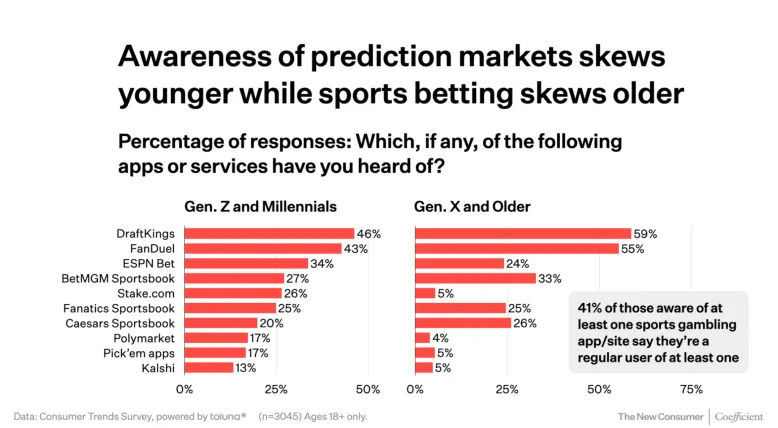
New sociological research indicates a rapid increase in the popularity of prediction markets in the U.S., especially among younger generations. According to a survey conducted by The New Consumer in collaboration with Coefficient Capital, 31% of Americans believe that prediction markets will become an even more important part of national culture. This percentage is significantly higher among Generation Z and millennials.
This is reported by Business • Media
Growing Awareness and Engagement Among Youth
The study surveyed over 3,000 consumers from various regions of the U.S. It showed that Generation Z is increasingly choosing prediction markets, preferring them over other financial instruments. Awareness of key market platforms varies significantly by age: 17% of young respondents (Gen Z and millennials) are aware of Polymarket, while among older generations, this figure is only 4%. For Kalshi, the awareness level is 13% among youth compared to 5% in older age groups.
Polymarket and Kalshi have already achieved a combined market valuation of around $20 billion amid record user activity. In particular, Kalshi raised $1 billion in funding at an $11 billion valuation, while the owner of the New York Stock Exchange, Intercontinental Exchange (ICE), invested $2 billion in Polymarket at a $9 billion valuation.
Market Dynamics and Regulatory Progress
The analytics platform Dune claims that Kalshi processes between $1.7 and $2.3 billion weekly, while Polymarket handles between $1 and $1.7 billion. According to Google, American interest in prediction markets after the 2024 elections remains 20 to 30 times higher than before this period.
“When respondents were asked about the impact on ‘everyday life,’ 34% believe that sports betting will become more significant, while 31% think prediction markets will (statistically a near tie). Another 38–39% expect everything to remain about the same.”
Additionally, 41% of respondents regularly use at least one sports betting app. The regulatory policy regarding prediction markets in the U.S. has also undergone significant changes: after a prolonged standoff, the Commodity Futures Trading Commission (CFTC) under Michael Seliga has taken a favorable position towards the development of this industry. Polymarket returned to the U.S. market at the end of 2025 with CFTC approval, and Kalshi’s legal victory in May 2025 opened federal markets for political events, although some states remain resistant.
Interest from institutional players is also growing: over half of ICE’s clients are interested in analyzing Polymarket’s prediction markets to assess their impact on their financial strategies.
The spread of prediction markets occurs against a broader trend—young people in the U.S. are increasingly trusting new financial instruments, including cryptocurrencies, over traditional banks. According to Protocol Theory, 56% of young users prefer self-custody of assets.
The next major test for prediction markets will be the 2026 FIFA World Cup, during which betting volumes are expected to reach $35 billion. Already, a third of young Americans believe that prediction markets are not a temporary trend but a future part of the country’s financial and cultural infrastructure.
At the same time, Polymarket has signed a multi-year partnership agreement with the United States Football League, which could further popularize this segment of financial markets among youth.
