

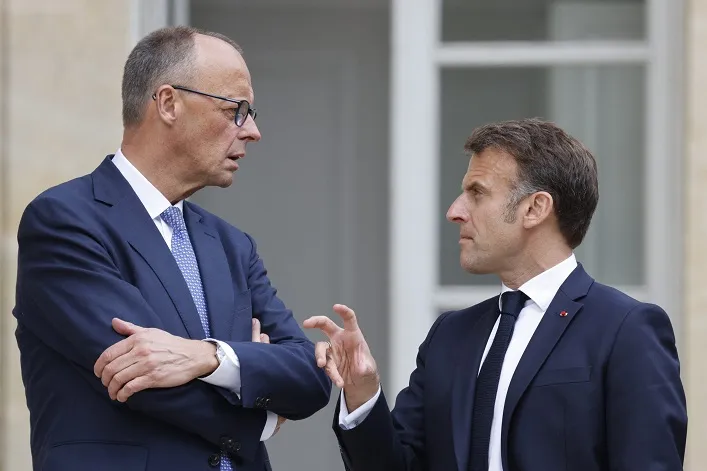
France and Germany announced the provision of additional air defense systems to Ukraine in response to the massive missile strikes by the Russian Federation, including the attack on Kyiv carried out on August 28. This was stated by German Chancellor Friedrich Merz and French President Emmanuel Macron after a cabinet meeting in Toulon.
This is reported by Business • Media
Joint Actions in Security and Strategic Dialogue
According to their statements, both countries plan to coordinate their security efforts more closely. In addition to strengthening Ukraine’s air defense, France and Germany agreed to initiate a “strategic dialogue” on issues of nuclear deterrence and the adaptation of defense and security policies.
Furthermore, the leaders called for the implementation of secondary sanctions aimed at undermining the economic capabilities of the Russian military machine. They emphasized the need to increase pressure on Moscow to force the aggressor country to come to the negotiating table.
“The most damaging sanctions for the Russians will be in the energy sector. Also, all secondary sanctions, such as those imposed by the Americans. Additionally, a blow to financial services that would hinder their access to capital,” detailed Kaja Kallas.
Prospects for Supporting Ukraine and New EU Sanctions
German Chancellor Friedrich Merz emphasized that Russia’s war against Ukraine could drag on for many months, so support for Kyiv from European partners must remain stable and long-lasting.
At the same time, the EU’s High Representative for Foreign Affairs Kaja Kallas reported that within the framework of the 19th package of restrictions, EU countries are considering a number of new economic sanctions against Russia. Special attention is being paid to measures in the energy sector, as well as the introduction of secondary sanctions and restrictions in financial services that could complicate Russia’s access to external capital.