

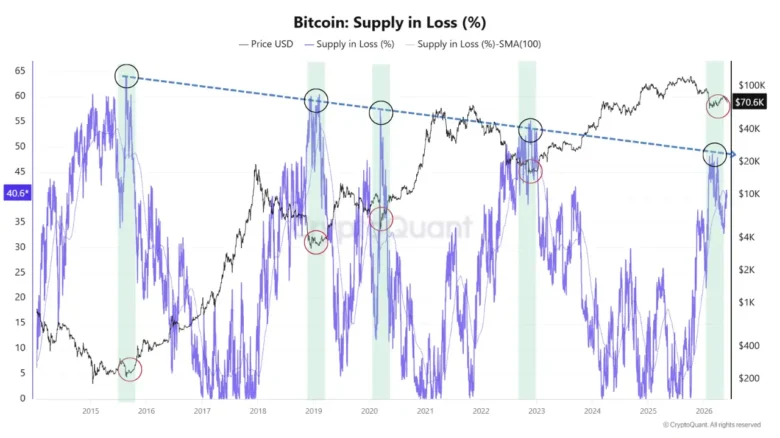
The current situation in the cryptocurrency market shows an increase in the share of bitcoins in losses to 40.6%, which, according to analysts, may indicate the approach of a market bottom. Experts emphasize that historically, such levels of losses have usually preceded the formation of minimum price marks for bitcoin.
This is reported by Business • Media
Structural Changes in the Bitcoin Market
The analytical company CryptoQuant reports that since 2015, every significant minimum in the price of bitcoin has coincided with testing the descending trend line of the percentage of coins in loss. With each new market cycle, fewer coins in loss are needed to form a bottom, and the current critical level is estimated to be approaching 40%.
“The share of bitcoin supply in loss has risen to 40.6%. Analysts at CryptoQuant stated that such values have historically coincided with the formation of cyclical minimums for bitcoin.”
Experts note that currently, the majority of bitcoins are concentrated among long-term holders, institutional investors, and ETFs, which have a higher tolerance for market fluctuations. This leads to a structural change in the market, and the accumulation of loss-making supply occurs at lower percentages than in previous years.
Analysts point out that the current level of loss-making supply demonstrates high market stress but has not yet reached levels that are historically considered optimal for large-scale accumulation. If the decline in bitcoin continues, a re-test of the multi-year structure may open new opportunities for investors looking to enter the asset.
In addition to technical factors, experts highlight the psychological aspect: the increase in the number of loss-making coins is often accompanied by a shift in market participants from optimism to uncertainty and prolonged waiting. It is during such moments that weak participants leave the market, while long-term investors actively buy assets.
Decline in On-Chain Activity and Capital in Stock Shares
According to data from Santiment, on-chain activity in the bitcoin network has significantly decreased. The number of active addresses and new wallets has dropped by more than 40% compared to the peak values of 2021. In May 2021, over 1.12 million active addresses and 489 thousand new ones were registered daily, while these figures have now fallen to 624 thousand and 278 thousand, respectively.
Experts explain that the decrease in the number of active addresses and new wallets indicates a reduction in retail activity against the backdrop of the growing role of institutional investors and ETFs. The latter allow access to bitcoin without the need to open new addresses or directly interact with the blockchain.
These factors lead to the formation of high market capitalization with lower network activity. At the same time, Santiment emphasizes that low activity values do not always indicate an approaching bearish trend — often, sharp price fluctuations stimulate the return of users and an increase in transactions.
Another important trend has been the growing preference of investors for traditional assets. Over the past month, the S&P 500 index has risen by 4%, while bitcoin has lost 13%, and gold has lost 5%. Experts link this to positive expectations from the policies of U.S. President Donald Trump, which add confidence to the stock market and stimulate the flow of capital from cryptocurrencies into American stocks.
At Santiment, it is noted that the growing gap in returns between bitcoin and traditional assets may lead to further outflows of investment from the cryptocurrency market. However, this trend is not permanent — historically, periods of pessimism in the cryptocurrency market and FOMO in stock exchanges have often alternated, affecting subsequent investor sentiment.
It is worth noting that by the end of May, bitcoin and Ethereum finished the month with declines, and nearly 3 billion dollars were withdrawn from ETFs amid geopolitical tensions.