

NEAR Protocol has announced the implementation of post-quantum cryptography by the end of the second quarter of 2026, which is this month. This was reported by the project’s co-founder Ilya Polosukhin, confirming that testing of post-quantum signatures will start in the network’s testnet, and the implementation in the main network will depend on the success of the first stage, although exact timelines remain unknown.
This is reported by Business • Media
Context of the Quantum Technology Threat to Cryptocurrencies
Bitcoin and most other cryptocurrencies currently rely on cryptographic algorithms using elliptic curves (ECDSA/secp256k1), which are believed to be breakable by a quantum computer operating on Shor’s algorithm. In March 2026, Google released a report stating that breaking 256-bit elliptic cryptography requires 20 times fewer quantum resources than previously anticipated — less than 500,000 physical qubits.
Google has also developed two quantum algorithms for analyzing cryptography: one uses fewer than 1200 logical qubits and 90 million Toffoli gates, while the other uses 1450 qubits and 70 million gates. These results have been validated by a zero-knowledge proof (ZKP).
The founder of EigenCloud, Sriram Kannan, also shared insights from his work in cryptography. Researchers from his team were able to significantly improve Google’s algorithms: undergraduate student Gautam Anant doubled the efficiency of Google’s public algorithm using OpenAI Codex, while Gajesh Naik, using a swarm of several models, achieved 80% of the potential of the private algorithm.
“Let me clarify: this alone will not lead to the hacking of Bitcoin. It reduces the number of qubits and logical gates needed to create a quantum computer capable of doing so, thus accelerating the development of quantum technologies. In any case, it is time for the Bitcoin community to consider the post-quantum cryptography era,” emphasized the founder of EigenCloud.
Google predicts that cryptography will become vulnerable to quantum attacks as early as 2029. Kannan stressed that his research only confirms this scenario, and the Bitcoin industry must prepare for a transition to post-quantum technologies.
NEAR Protocol’s Post-Quantum Approach
Following Google’s report, Near One’s Chief Technology Officer Anton Astafiev published a detailed overview of NEAR Protocol’s transition to post-quantum cryptography. He emphasized that the industry can no longer rely on a significant buffer of time to adapt to the emergence of quantum computers.
“As an industry, we can no longer assume that we have time to figure everything out, or that a functional quantum computer will only appear decades from now,” he stressed.
The NEAR network currently uses the EdDSA (Ed25519) algorithm and supports ECDSA (secp256k1), but neither of these methods is resistant to quantum attacks. In the future, the implementation of the FIPS-204 algorithm (ML-DSA, previously known as CRYSTALS-Dilithium), which is based on mathematical lattices and was approved by the U.S. National Institute of Standards and Technology (NIST) in August 2025, is planned.
Unlike Bitcoin and Ethereum, NEAR’s architecture allows each account to have multiple access codes with different levels of functionality, rather than just a standard key pair. To protect against quantum attacks, users only need to add another key using the ML-DSA algorithm, which will allow them to sign transactions using a quantum-resistant method.
At the same time, this approach has its challenges: ML-DSA signatures are significantly larger in size (2420 bytes compared to 64 bytes in Ed25519), which increases the computational resource requirements of the network and will impact transaction costs (gas). According to Astafiev, implementing the new algorithm for the entire infrastructure is a more complex task than updating individual components.
According to Polosukhin, testing of post-quantum signatures will begin in the testnet at the end of the second quarter of 2026. The date for implementation in the main network will depend on the results and effectiveness of the testing phase.
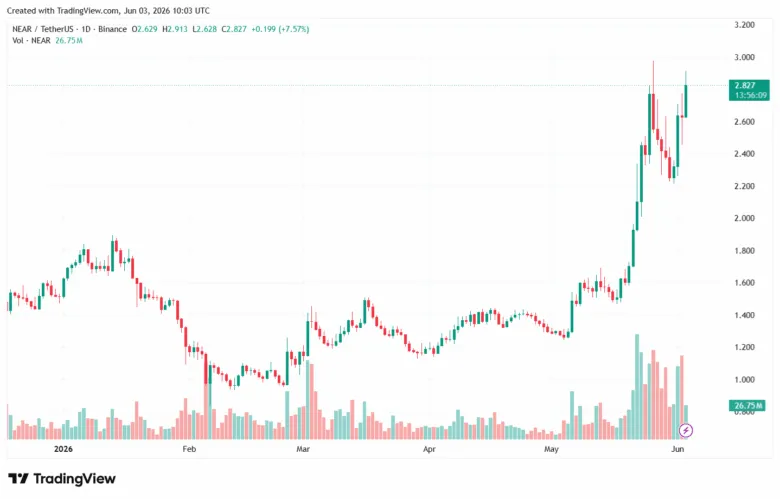
In light of recent announcements and technical updates, the native NEAR token is showing positive dynamics: daily growth was 7.7%, and weekly growth exceeded 10%.

Earlier, Coinbase also released an analytical report on the quantum threat and security measures being implemented across various blockchain networks.